
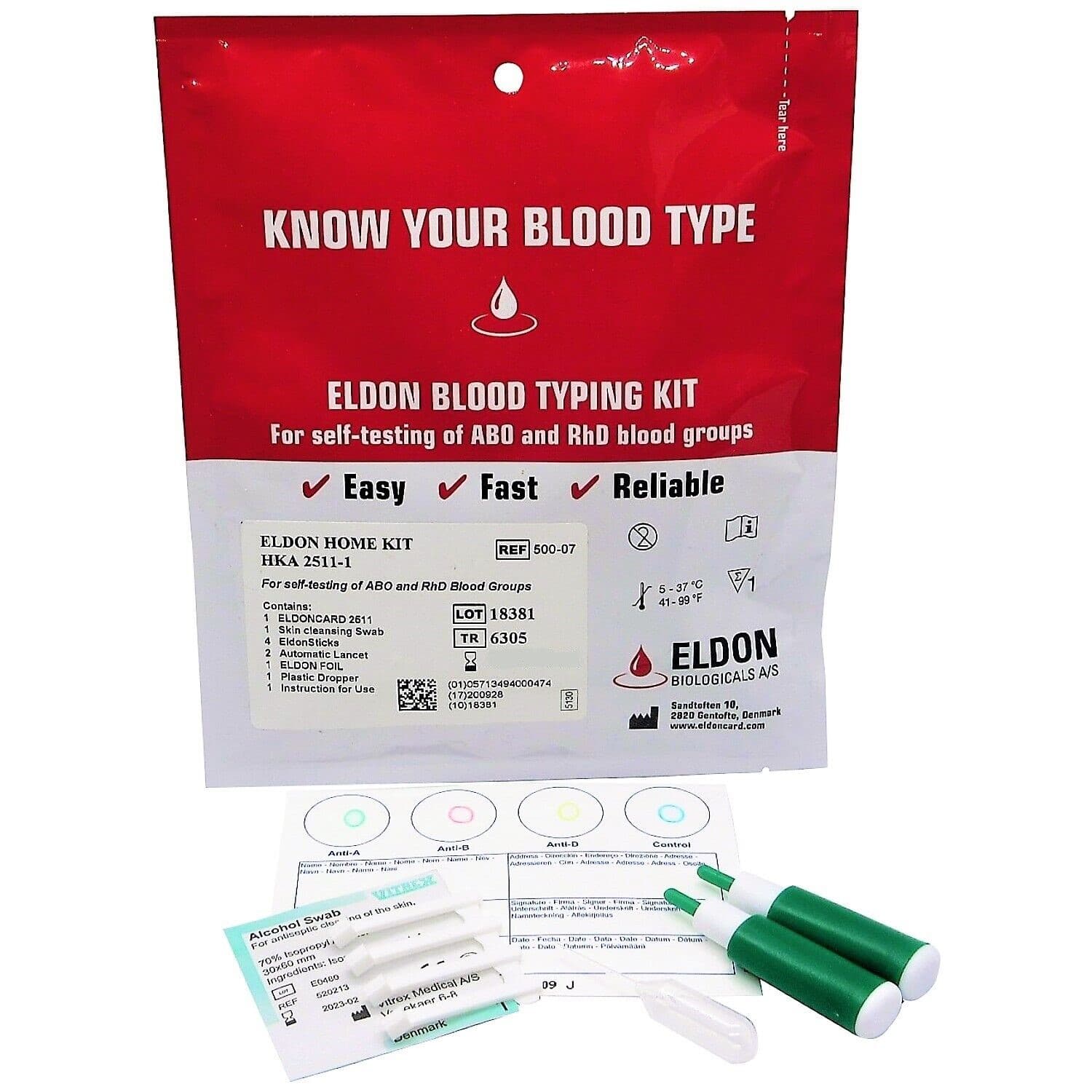
Blood Type Test Kit - Group A B O and Rhesus D
This test determines your ABO blood group and Rhesus D status from a finger-prick blood sample, giving you one of the eight common blood types. Knowing your blood type is useful for donation, for pregnancy planning where Rhesus status matters, for travel, and simply as personal health information many people never get told. The kit uses the same antibody-based agglutination method used in laboratories: your blood is mixed with anti-A, anti-B and anti-D reagents, and the pattern of clumping reveals your type. Results are visible within a few minutes.
Intended use
For adults who want to know their ABO and RhD blood group at home. Not a substitute for laboratory typing before transfusion.
What this test measures
Your blood type is determined by antigens — markers — on the surface of your red blood cells. The ABO system (A, B, AB or O) and the Rhesus D antigen (positive or negative) together make up the blood group most commonly referred to in medical and personal contexts. This test identifies your ABO and RhD status using antibody reactions, the same principle used in clinical blood typing.
What’s in the box
- 1×ELDONCARD blood typing card (Anti-A, Anti-B, Anti-D and Control circles)
- 2×Automatic lancet
- 4×EldonStick mixing sticks
- 1×Plastic dropper
- 1×Skin cleansing swab (70% isopropyl alcohol)
- 1×Eldon foil
- 1×Instructions for use
How you do it
No lab, no appointment, nothing to post. Most people finish the sample step in under two minutes.
- 1Add water to the four circles1 min
Put a droplet of clean water (not included) on each of the Anti-A, Anti-B, Anti-D and Control circles on the card. This activates the dried reagents.
- 2Clean and prick your fingertip1 min
Wipe the side of a fingertip with the alcohol swab and let it dry, then use the automatic lancet. Warm hands bleed more easily.
- 3Transfer blood to each circle1 min
Use the dropper or a clean EldonStick to place a drop of blood onto each of the four circles.
- 4Mix each circle with a clean stick1 min
Use a separate EldonStick for every circle. Reusing a stick will carry reagent across and invalidate the result.
- 5Tilt the card and read the pattern2 min
Rock the card gently. Circles where blood clumps read as positive, smooth circles as negative. Compare against the chart to find your group.
- 6Check the control circle30 sec
The Control circle must stay smooth. If it clumps, the test is not valid and should be repeated.
What your result will mean
Worth knowing before you test, not after.
Storage & preparation
Store at 2-30°C, away from direct sunlight
Questions people ask
Can I use this result for a transfusion or medical record?
No. Treat it as personal information only. Hospitals always type blood themselves before a transfusion, and pregnancy care relies on laboratory typing. This test is for your own knowledge, not as an official record.
What is the Rhesus D factor?
Rhesus D is a protein some people carry on their red blood cells (RhD positive) and some do not (RhD negative). Combined with your ABO group it gives one of the eight common blood types, such as O positive or A negative.
What if the control circle clumps?
The Control circle should stay smooth. If it clumps, the test has not run correctly and the result cannot be relied on. Repeat with a fresh card.
Does the finger-prick hurt?
Most people describe it as a brief sharp scratch, similar to a diabetes blood glucose check. The lancet is spring-loaded so the depth is fixed and controlled. Warming your hands first and using the side of your fingertip rather than the pad usually makes it easier.
Can I work out my baby's blood type from mine?
Not exactly. Blood type is inherited from both parents, so knowing yours narrows the possibilities but rarely gives a single answer. Both parents' types are needed even to predict a range.
How much blood do I actually need?
A small drop for each of the four test circles — about four drops in total. The kit's EldonSticks make this easy to control one circle at a time.
Complete the kit
This test uses a finger-prick sample. Spare lancets are worth having in case a first sample doesn’t draw cleanly.